
Science & Clinical Method

The science of insomnia: how it works and how sleep medicine treats it.

Insomnia is not one condition. It breaks sleep in four distinct mechanisms (onset, maintenance, early-morning awakening, and non-restorative), and each one responds to different medications and behavioral protocols. This page explains the mechanisms, the medications including doxepin and DORAs, and the role of CBT-I.

4Insomnia patterns
3Medication mechanisms
1Behavioral protocol (CBT-I)
Start Sleep Assessmentarrow_forward
Pattern atlas

Four patterns of sleep breaking

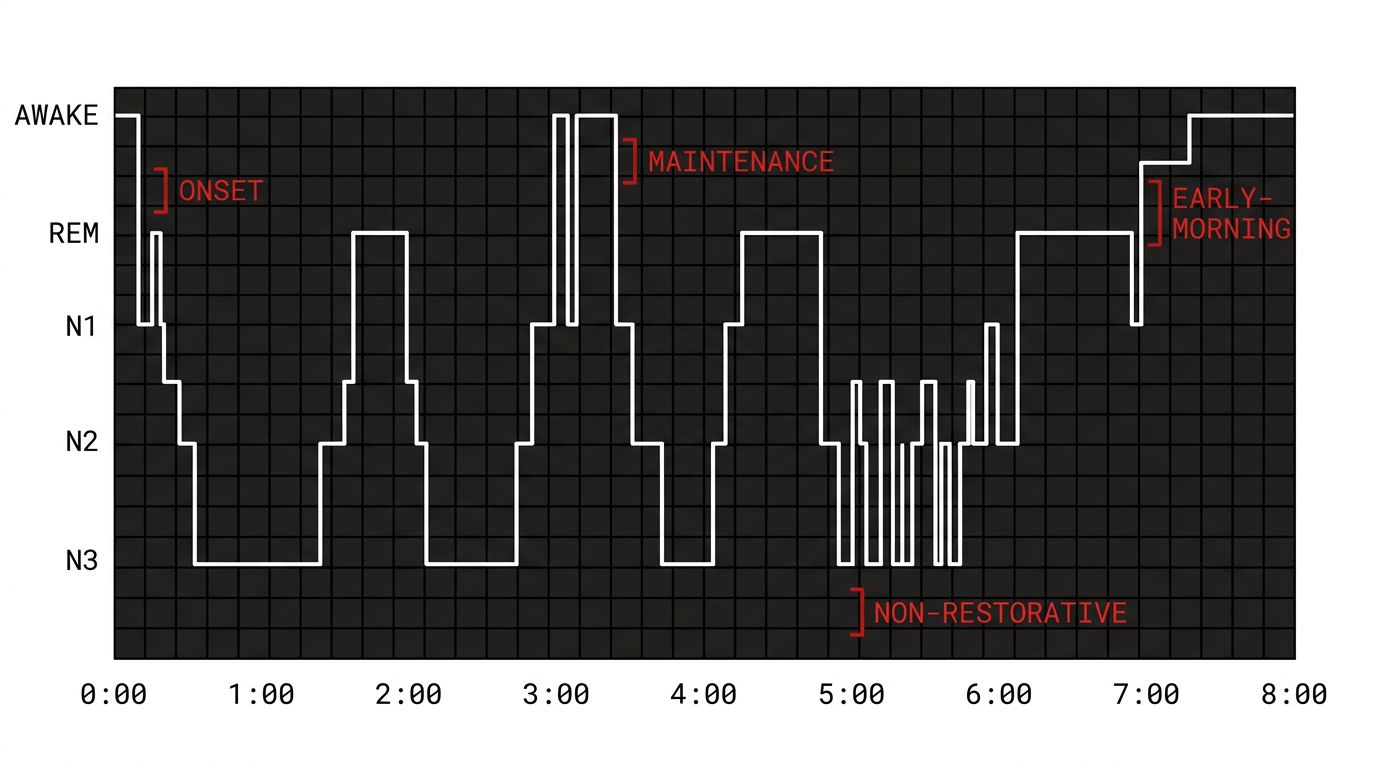
Sleep architecture diagram showing a hypnogram across one night with four red bracket annotations marking where each insomnia pattern manifests: onset at sleep onset, maintenance around 3 AM, early-morning awakening near morning, and non-restorative sleep across the fragmented second half of the night.
Where each pattern breaks the night.

Onset insomnia

“My brain won’t turn off.”

You get into bed and the tape is still running. An hour passes, sometimes two. You watch the minutes go by.

Mechanismexpand_more

Onset insomnia is most often a problem of cortical arousal at the sleep-wake threshold. The systems that should be ramping down (sympathetic tone, cortical attention, the hypothalamic alerting signal) are still up. Melatonin timing can be misaligned, and the GABA-driven sedation that closes out the day is not engaging cleanly. The treatments that target this pattern are different from the ones that treat early waking.

Maintenance insomnia

“I fall asleep fine but I can’t stay asleep.”

You wake at 2 or 3 AM, like clockwork, and lie there for two more hours with the 3 AM horrors looping in your head.

Mechanismexpand_more

Maintenance insomnia typically reflects a problem of sustained sleep. Histamine and orexin signaling reactivate during the second half of the night, and cortisol begins its morning ramp earlier than it should. The brain effectively wakes itself up and cannot get back under. Selective histamine-1 antagonism at low doses is one of the mechanisms specifically validated for this pattern.

Early-morning awakening

“I’m up at 4 and I cannot get back down.”

You sleep the first stretch and then surface hours before you should, with your body saying it is daytime when it is not yet.

Mechanismexpand_more

Early-morning waking is often a circadian-phase issue layered with a sustained-sleep failure. The internal clock has advanced. The body is preparing for morning too early, and the sleep-stabilizing systems cannot hold against it. Treatment here is about both phase correction and maintaining sleep architecture through the second half of the night.

Non-restorative sleep

“I got my hours but I feel like I didn’t sleep.”

Wired but tired the next morning, fogged through the afternoon, with a tracker that says you slept and a body that disagrees.

Mechanismexpand_more

Non-restorative sleep is an architecture problem rather than a duration problem. Slow-wave sleep is fragmented, REM cycles are shallow or interrupted, and micro-arousals are not visible to consciousness but are very visible to a recovery score. Pattern work here often begins with a home sleep test to rule out sleep-disordered breathing before any medication conversation.

Pharmacology

The medications we work with

Doxepin (low-dose)3–6 mgSub-hypnotic dose

Selective H1 antagonism for sleep maintenance.

Mechanismexpand_more

At very low doses (3 to 6 mg), doxepin acts as a selective histamine-1 receptor antagonist, approved specifically for sleep maintenance. Its action concentrates in the second half of the night, where maintenance insomnia breaks. The antidepressant and anticholinergic effects at higher doses are largely absent.

H1 antagonistKrystal 2011 · Sleep
RamelteonMT1 · MT2Melatonin receptors

Melatonin receptor agonism without GABA sedation.

Mechanismexpand_more

Ramelteon is a melatonin receptor agonist (MT1 and MT2). It works on the circadian alerting signal rather than the GABA system, which is why it is non-scheduled and non-addictive. It supports sleep onset without the next-morning sedation profile of GABA-active hypnotics.

MT1 / MT2 agonistRoth 2006 · J Clin Sleep Med
Dual orexin receptor antagonists (DORAs)OX1 · OX2Orexin receptors

Removes wake drive instead of broad sedation.

Mechanismexpand_more

DORAs block the orexin signaling that keeps the brain in a wakeful state. Rather than sedating broadly, they remove the wake drive — a different pharmacology from benzodiazepines or Z-drugs. Their use is determined by pattern profile and treatment history.

Orexin antagonistSUNRISE-2 · 2019
Evidence base

The clinical literature behind these decisions

01
Featured · Guideline

Clinical Practice Guideline for the Pharmacologic Treatment of Chronic Insomnia in Adults

First-line behavioral therapy (CBT-I) recommended; selective drug recommendations by pattern.

AASM · J Clin Sleep Med · 2017
02

Sustained efficacy of doxepin 3 mg and 6 mg in chronic primary insomnia

Selective H1 antagonism at very low doses improves sleep maintenance without next-day residual effects.

Krystal et al. · Sleep · 2011
03

Efficacy and safety of ramelteon in subjects with chronic insomnia

MT1/MT2 melatonin receptor agonism reduces sleep onset latency without GABA-system effects.

Roth et al. · J Clin Sleep Med · 2006
04

SUNRISE-2: Suvorexant for insomnia disorder

Dual orexin receptor antagonism improves both onset and maintenance versus placebo.

Herring et al. · J Clin Sleep Med · 2019
05

SUNRISE-1: Lemborexant in adults with insomnia

Lemborexant outperforms zolpidem extended-release on sleep maintenance metrics in older adults.

Rosenberg et al. · Sleep · 2019
Behavioral foundation

CBT-I: the foundation, not the ceiling

Cognitive Behavioral Therapy for Insomnia is the first-line, guideline-recommended treatment for chronic insomnia. The evidence base behind it is real, and for many patients it is sufficient on its own. Our behavioral program, Sleep Reset, is built on this foundation.

And CBT-I does not work for everyone. If you have completed a full CBT-I protocol and the pattern persists, that is not a failure on your part. It is a signal that the case is more complex than the behavioral lane alone can address. The right next step is a clinical evaluation that asks which mechanism is still driving the break, and matches a pharmacological lane to it. CBT-I remains underneath, because the behavioral work continues to support medication response. The two layers compound; they do not compete.

Your Care Team

Board-certified sleep specialists

Board-certified specialists in Neurology, Psychiatry, Pulmonology, or Behavioral Sleep Medicine. Each holds a focused sleep-medicine caseload.

View Full Directoryarrow_forward
A distinguished female doctor in a crisp white lab coat over a dark shirt, standing in a quiet, dimly lit modern clinic.
14 yrs in sleep medicine

Dr. Sarah Chen

MD, PhD • Neurology, DABSM

Specializes in circadian rhythm disorders and shift-work sleep disruption.

A thoughtful male physician wearing dark, professional attire under a lab coat, pictured in an understated, minimalist office space.
11 yrs in sleep medicine

Dr. Marcus Vance

MD • Psychiatry, DABSM

Focuses on psychophysiological insomnia and trauma-related sleep disturbances.

A portrait of a confident female clinician in dark scrubs, set against a deeply shadowed background.
17 yrs in sleep medicine

Dr. Elena Rostova

MD • Pulmonology, DABSM

Expert in complex sleep apnea syndromes and non-invasive ventilation.

A male sleep specialist looking directly at the camera with a reassuring, quiet intensity.
9 yrs in sleep medicine

Dr. Julian Hayes

DO, PhD • Behavioral Sleep Medicine (CBSM)

Pioneer in advanced cognitive behavioral therapy for chronic insomnia (CBT-I).

Next step

Find out which pattern you have

The Sleep Pattern Assessment names your dominant pattern, surfaces apnea risk indicators, and routes you into the pathway that fits.